

Working in height
• Ladder
Work in freestanding ladder should be brief (Stepladder)
• Maximum permissible standing height is 4 meter
• Standalone ladder higher than 6 meter must not be used
Use of inclined ladder (ladder standing against the wall)
- Ladders higher than 5 meters must be secured before use
- Never stand with your head higher than 7 feet above the ground.
- Work in inclined ladder should be brief
- Ladder used as access to the roof, should stand at least 1 meter above the roof
- When working on ladders, you must secure the ladder for movements.
- Ladders used several times as access must always be secured at the top
- Right angle to the wall / construction.
- Ladder must be placed on level ground and be secured for stability
- Ladder must be secured against slippage, tipping sideways or backwards.
- Make sure the ladder is not broken
- Never carry anything in your hands if you should climb higher than 1,5meter.
- You should always use two hands when climbing ladder
- Never lean too much on the side of the ladder, the ladder can then slip.
- Make sure the plugs and end blocks are present and fit tightly,
- And that all 'step' / planks sit steady and tightly.
- The ladders must be marked with NS-8070 or NS-INSTA 650.
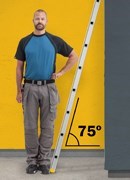
Follow 4: 1 rule when using ladder for each meter ladder goes up so will the ladder leg 35 cm from the wall.
• Lift
Do not use the lift as a crane
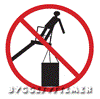
Do not use the lift
- On soft ground
- On surfaces that have steeper slope than what is legal
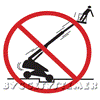
Avoid collisions with fixed or moving obstacle
Never move the maneuvering levers from one direction to the opposite without making a stay in the "O" position.
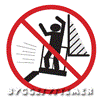
Never climb on the railing when the platform is hoisted
Never climb over the railing (use the stairs).
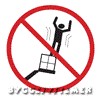
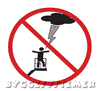
Using a lift outdoors:
When there is danger of lightning do not use the lift.
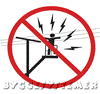
Keep a safe distance from power lines, a minimum of 20 meters.
• Roof
Brief work on flat roofs #
Should we perform very brief duration (maximum 5 minutes) on flat roofs that are closer than two meter from the edge, you have to crawl. You do not under any circumstances be allowed to go closer to the edge than two meters unless you crawl.
Should you peek over the edge you MUST lie down on the roof and one are Never allowed to lean farther out over the edge than the shoulders. Small and short-term work on flat roofs that is closer than 2.0 meters from the roof edge shall be performed with the use of personal fall protection equipment.
Unless you have a physical barrier as a fence on the roof, should all work that is closer to the edge than 2 meters performed crawling. Although we have a personal fall protection equipment.
When working on roofs with a slope / pitched roofs as see own instructions.
Criteria for work to be described as briefly #
• It only involves inspection, minor repairs or maintenance
• The total scope of work shall not exceed 4 hours worked
Brief work on sloping roof
Working on sloping roofs or other places where you can fall down if you lose consciousness or slips.
We at SBM should never do a job where we rely on climbing equipment.
We at SBM should only do jobs where you can walk safely without using fall equipment / climbing equipment.
Climbing equipment / fall equipment are intended as a safeguard if you lose consciousness or slips.
Should we perform works where one is dependent on climbing equipment / fall protection you should have a separate certification.
Instructions for works where one must use fall protection equipment
Fall protection equipment is intended as an additional security, and should therefore not be under strain before an eventually fall.
It shall be possible to move safely on the roof using a ladder or etc., you must never use fall protection equipment as a tool to stay up, move around.
One should never move on ceilings that are slippery, instead use a ladder or etc. that you can move around safely.
If the work cannot be performed without straying or being dependent on fall protection equipment the work shall not be preformed.
There should always be two people present when the work is performed.
There should always be two people who check that fall protection equipment is set appropriately.
Anchoring point should withstand three times as much as you think is strong enough.
Example, if you think a small pipe is strong enough as anchorage point shall be mounted in the chimney which is 3 times as large to be sure it is strong enough to hold if the person falls
When working with fall protection must the length of the rope never be longer than that you maximum fall 1 meter from the ceiling.
One must therefore use rope that can be regulated or equipment that automatically regulates the rope while you work.
See instructions from the manufacturer of fall protection equipment
• Scaffolding
Use of scaffolding / work platform
- Use when working longer duration
- Work Platform over 2 meters standing height shall be secured by railings which shall consist of a handrail, intermediate rails and toe boards
- For uneven surfaces with a working platform lower than 2 meters there shall be considered whether there is need for securing with railings.
Scaffolding where headroom is higher than 5 meters, should only be built by someone who has certification to build scaffolding.
If you are working on scaffolding that is higher than 5 meters so you should undertake training BEFORE you go on the scaffolding.
• Working with a lifter
Lift should ONLY be used by people with Personnel lift certificate.
User's Guide for the lift shall be followed.
• When using the lift, scissor platforms etc. there should always be given user training from supplier.
• Must make them selves familiar with and sign the instructions for use of Personnel lift
